
You’ve probably tried to figure out why you feel the way you do.
The fatigue that sleep doesn’t fix.
The brain fog that shows up out of nowhere.
The low mood, congestion, or inflammation that just won’t go away.
So you do what everyone does:
And still… nothing fully clicks.
Here’s the part most people overlook:
 The problem might not start in your body
It might be coming from your environment
And that’s what makes it so easy to miss. Because when symptoms don’t have a clear cause, most people assume they just need to “try harder” with diet, workouts, or supplements. But if the root issue is something you’re exposed to daily, no amount of optimization will fully move the needle until that piece is addressed.
This is exactly what Julie went through before discovering mold toxicity.
Mold exposure isn’t always obvious.
It’s not just visible spots on walls or ceilings.
The real issue is what mold produces: mycotoxins.
These are toxic compounds that can quietly build up in your body over time.

They can disrupt:
Detoxification pathways
Which is why symptoms often show up as the following:
Persistent fatigue
Brain fog
Sinus or respiratory issues
Mood changes
Chronic inflammation
And here’s where it gets frustrating…
These symptoms overlap with almost everything else.
So most people never connect it back to mold.
What makes this even more complicated is that mold exposure isn’t always constant or obvious. You might feel worse at home, slightly better when you travel, then worse again when you return. These subtle patterns are easy to dismiss, but they can be one of the strongest clues that your environment is playing a role.
Julie didn’t discover mold by testing her home first.
She discovered it through her body.
The OAT (Organic Acids Test) revealed patterns consistent with mold toxicity long before the environment was confirmed.
That insight changed everything.
Recovery wasn’t instant:
But identifying the root cause made healing possible.
And this is the part most people underestimate. When the body is dealing with ongoing toxin exposure, it diverts energy away from repair and recovery just to keep up. Until that burden is identified and reduced, progress can feel slow, inconsistent, or completely stalled.
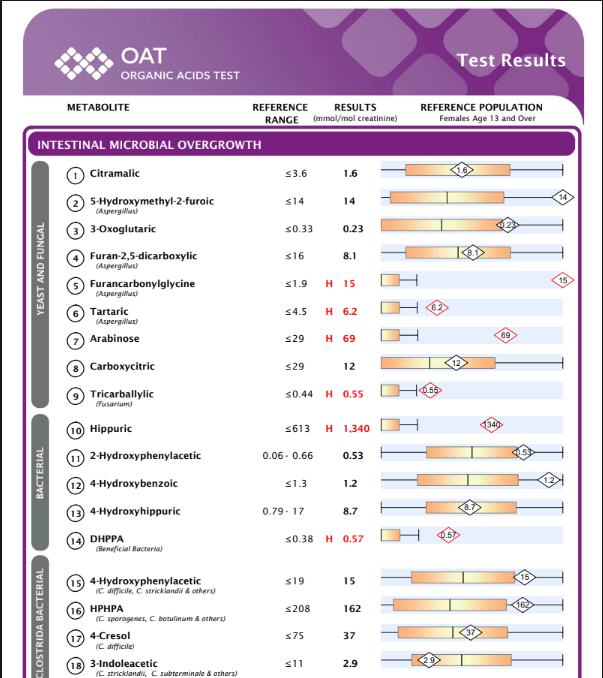
This is what functional testing can reveal, patterns that standard labs often miss.
Instead of just showing whether something is “high” or “low,” these reports highlight how different systems in the body are functioning together. It’s less about isolated numbers and more about understanding patterns that point to underlying stress, toxicity, or imbalance.
You can test your home.
But if your body is already affected…
That’s where the real story shows up.
The OAT test looks at:
It gives a functional snapshot of what’s actually happening inside your body, not just what might be in your environment.
This is especially important because not everyone reacts to mold exposure the same way. Some people can be in the same environment and feel completely fine, while others experience significant symptoms. Testing your body removes the guesswork and helps you understand how your system is responding specifically.
If you’ve been dealing with symptoms like this, it’s worth checking.
You can:
The key is to start gathering real data instead of continuing to guess. Even one test can provide clarity that changes the direction of your entire health approach.
Mold is one of the most overlooked root causes behind chronic symptoms.
And it doesn’t just “go away” on its own.
The sooner you identify it,
the sooner you can actually do something about it.
Because at the end of the day, your body isn’t working against you; it’s responding to something. The goal is to figure out what that “something” is, so you can finally support it in the right way.
